
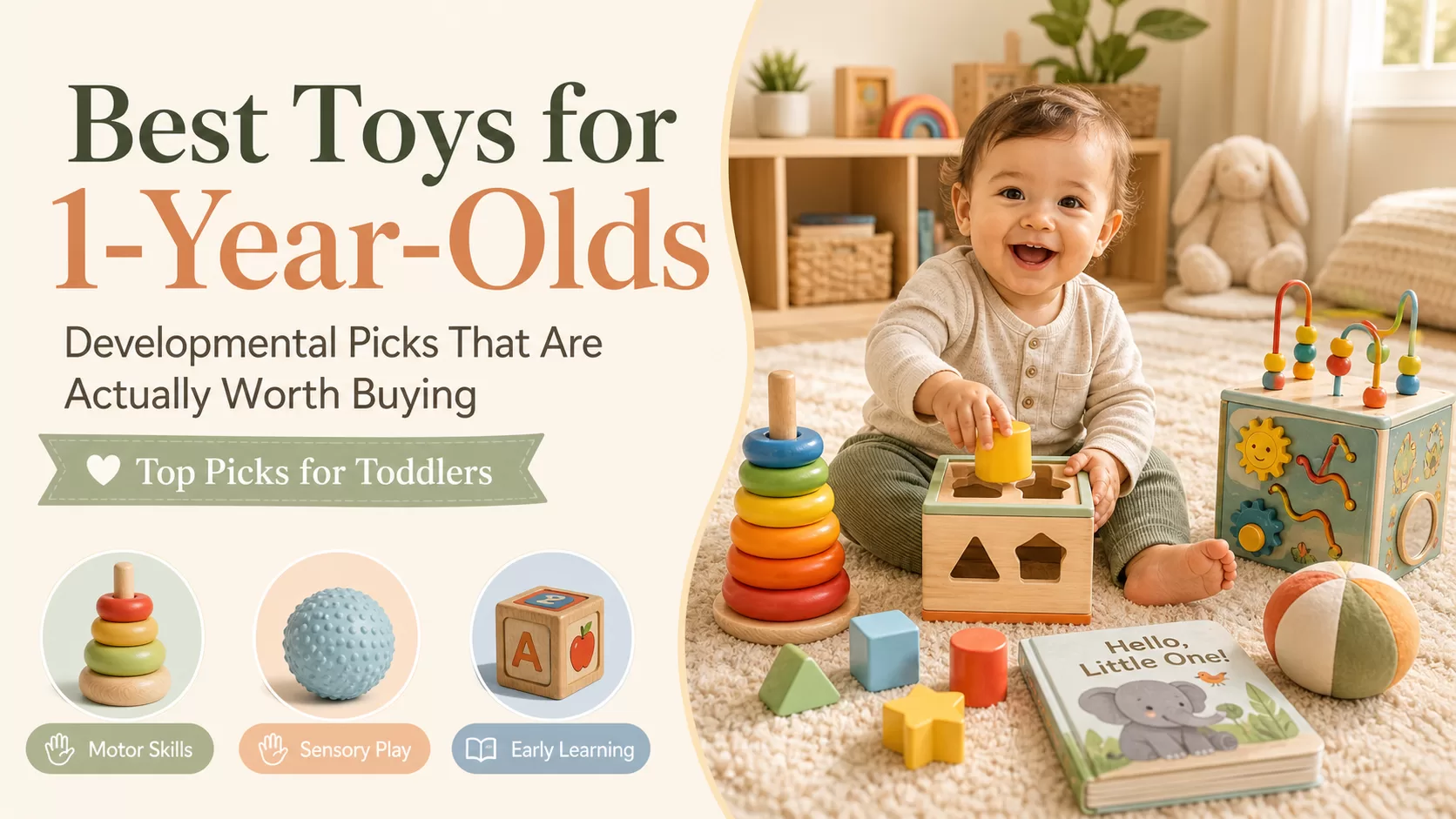
One-year-olds are curious, active and constantly learning. At this age, a toy is not just something that keeps a child busy. The right toy can help a toddler practice balance, hand control, problem-solving, language, sensory exploration and early independence.
But not every toy marketed for a 1-year-old is worth buying. Some toys are too noisy, too complicated, too overstimulating or quickly ignored after a few days. The best toys for 1-year-olds are usually simple, safe, open-ended and easy for small hands to explore.
This guide compares the best developmental toys for 1-year-olds, including stacking toys, shape sorters, activity cubes, push toys, musical toys, soft books, sensory toys and pretend play basics. The goal is not to buy more toys. The goal is to buy better toys that your child can actually use, repeat and grow with.
Affiliate disclosure: Some of the links in this article may be Amazon affiliate links. KiddBuzz may earn a small commission from qualifying purchases, at no extra cost to you. We only recommend toys that are relevant, age-appropriate and useful for parents to compare before buying.
What Should a 1-Year-Old Be Learning Through Play?
At around 12 months, many babies are starting to stand, cruise along furniture, take early steps, use their hands more confidently, respond to simple words and explore objects in more intentional ways.
The best toys for 1-year-olds should support real developmental skills, such as movement, coordination, problem-solving, language, sensory exploration and early pretend play. A good toy does not need to be expensive or filled with lights and sounds. In many cases, simple toys like blocks, cups, books and balls are more useful because they encourage active play.
When choosing toys for a 1-year-old, look for toys that support:
Fine motor skills, such as grasping, stacking, dropping and fitting shapes.
Gross motor skills, such as crawling, standing, pushing, pulling and walking.
Problem-solving, such as matching shapes, opening lids or figuring out cause and effect.
Language development, such as naming animals, colors, sounds and everyday objects.
Sensory exploration, such as textures, sounds, colors, movement and touch.
Pretend play, such as feeding dolls, pushing cars or copying everyday routines.
1. Activity Cube
Best for all-round developmental play
An activity cube is one of the most useful toys for a 1-year-old because it combines multiple activities in one toy. A good activity cube may include shape sorting, bead mazes, spinning gears, buttons, sliders, doors, textures or simple cause-and-effect activities.
For a one-year-old, this type of toy is useful because it encourages sitting, reaching, turning, pressing, pulling and problem-solving. It gives the child many small tasks to explore without needing screens or complicated instructions.
The PLUSPOINT 6in1 Baby Busy Activity Cube is a good example of this type of toy. It combines shape sorting and activity-based play, which makes it suitable for toddlers who enjoy touching, moving and exploring different parts of a toy.
Another affordable option is the Lefan Montessori Activity Busy Cube, which is designed around sensory and motor-skill play.
Activity cubes are best for parents who want one toy that supports multiple skills. However, avoid cubes with tiny detachable parts, sharp edges or overly loud sounds. For a 1-year-old, simple and sturdy is better than flashy and complicated.
2. Shape Sorter
Best for problem-solving and hand-eye coordination
A shape sorter is a classic developmental toy for a reason. It teaches toddlers how to match shapes, rotate objects, use hand-eye coordination and understand trial and error.
At first, a 1-year-old may not correctly match every shape. That is normal. The learning happens when they pick up pieces, try to fit them, turn them around and slowly understand that different shapes go into different spaces.
The Shumee Wooden Shape & Number House Sorter is a good option for parents who prefer a more natural wooden toy.
For a more budget-friendly plastic option, the WireScorts First Educational Blocks Shape Sorter can work well as a simple first shape-sorting toy.
Shape sorters are worth buying because children usually return to them many times. They are also easy for parents to use during play. You can name the shapes, colors and actions while your child explores.
For example, say: “This is a circle,” “Let’s try the red block,” or “You turned it around.” These small words help build early language while your child plays.
3. Stacking Cups and Stacking Rings
Best for fine motor skills and early logic
Stacking toys are simple, but they are extremely useful for 1-year-olds. Stacking cups, rings and blocks help toddlers practice grasping, placing, balancing, knocking down and rebuilding.
This kind of repetition is important. A child may stack two cups, knock them down, laugh and repeat the same thing again. That is not random play. It teaches cause and effect, size comparison, coordination and control.
Stacking cups are especially useful because they can be used in many ways. A toddler can stack them, nest them, hide small toys under them, use them in water play or knock them over. This makes them more open-ended than many battery-operated toys.
The Amazon Brand Jam & Honey Joy Box for Toddlers includes stacking-style play and can be a useful gift set for parents looking for a mix of simple toddler activities.
If you want a toy that lasts beyond a few weeks, stacking toys are one of the safest choices. They are simple, affordable and developmentally useful.
4. Soft Blocks or Large Building Blocks
Best for building, knocking down and early creativity
Blocks are one of the best toys for 1-year-olds because they grow with the child. At 12 months, a baby may only hold, mouth, bang or knock down blocks. A few months later, they may start stacking them. Later, they may build towers, houses and pretend structures.
Large blocks are better than small blocks for this age because they are easier to grip and safer for little hands. Avoid tiny blocks that can become choking hazards.
The Kidsmate Geometric Plastic Blocks are a budget-friendly option for simple building and shape play.
The LONGMIRE First Block Shape Sorter can also work if you want a toy that combines blocks and shape sorting in one product.
Blocks are worth buying because they encourage open-ended play. There is no single correct way to use them, which is exactly why they are so valuable.
5. Push Toy or Walker Toy
Best for early walking and gross motor practice
Many 1-year-olds are learning to stand, cruise or take their first steps. A sturdy push toy can help them practice balance and movement.
A push toy is different from a seated baby walker. A push toy allows the child to stand and push from behind, while a seated walker holds the child in a position that may not support natural walking development. For this age, a stable push toy is usually a better choice than a seated walker.
When buying a push toy, look for a stable base, smooth wheels, good grip and no sharp edges. It should not move too fast on smooth flooring. If the wheels have speed control, that is even better.
Push toys are useful for children who are ready to stand and move, but they should always be used with supervision. Avoid using a push toy near stairs, uneven flooring, slippery surfaces or sharp furniture edges.
6. Board Books and Touch-and-Feel Books
Best for language and bonding
Books are some of the most underrated toys for 1-year-olds. At this age, children may not sit through a full story, but they enjoy looking at pictures, touching textures, lifting flaps and hearing familiar words.
Touch-and-feel books are especially useful because they combine language and sensory play. You can point to animals, name objects, make sounds and encourage your child to turn pages.
Good first book themes include animals, fruits, vehicles, body parts, bedtime, family, colors and everyday routines.
Books are worth buying because they build habits early. Even a few minutes of reading every day can support language, attention and bonding. For a 1-year-old, choose sturdy board books with thick pages because they are easier to hold and harder to tear.
7. Musical Toys
Best for rhythm, listening and cause-and-effect play
Musical toys can be useful for 1-year-olds when they are not too loud or overstimulating. Simple instruments like rattles, drums, xylophones, shakers and small keyboards can help toddlers explore rhythm, sound and movement.
The key is to choose musical toys that allow the child to create sound through action. Pressing one button repeatedly on a noisy electronic toy is less valuable than shaking, tapping or striking something safely.
Musical toys are useful because they teach cause and effect. The child learns, “When I shake this, it makes a sound,” or “When I tap this, the sound changes.”
If you buy an electronic musical toy, choose one with volume control. Loud toys can become irritating for parents and overwhelming for toddlers. Simple sound-based toys are usually better than toys that flash lights constantly.
8. Sensory Toys
Best for touch, texture and exploration
Sensory toys help babies explore different textures, movements and sounds. For 1-year-olds, good sensory toys may include soft textured balls, pull-string toys, crinkle toys, pop-up toys, textured blocks and simple busy boards.
The Brand Conquer Montessori 7 in 1 Baby Sensory Toy is one example of a multi-activity sensory toy that includes activities such as shape sorting, pull strings, stacking blocks and other hands-on elements.
Sensory toys are useful because 1-year-olds learn by touching, squeezing, pulling, shaking and mouthing objects. However, safety is extremely important. Avoid toys with small detachable parts, weak strings, button batteries or loose beads.
A good sensory toy should be sturdy, easy to clean and safe for supervised play.
9. Balls
Best for movement, coordination and social play
A soft ball is one of the simplest and most useful toys for a 1-year-old. Toddlers can roll it, chase it, push it, throw it gently or pass it back and forth with a parent.
Ball play supports hand-eye coordination, movement, balance and social interaction. It also encourages turn-taking when you roll the ball to your child and wait for them to send it back.
Choose soft, lightweight balls that are easy to grip. Avoid small balls that can fit fully into the mouth. For indoor play, fabric balls or soft rubber balls are safer than hard balls.
This is one of the few toys that works well both indoors and outdoors. It is also a good toy for parent-child play because you can sit on the floor, roll the ball, clap, smile and encourage simple back-and-forth interaction.
10. Pretend Play Basics
Best for imitation and early imagination
At 1 year old, pretend play is just beginning. A toddler may pretend to drink from a cup, feed a doll, push a toy car or copy what adults do at home.
You do not need a big pretend kitchen or expensive play set at this age. Simple items work better. A soft doll, toy phone, toy cup, large toy car or animal figures can be enough.
Pretend play supports language, memory, social understanding and emotional development. It also gives parents many chances to talk naturally.
For example, while playing with a doll, you can say: “Baby is sleeping,” “Let’s give baby milk,” or “Baby is happy.” These small phrases help your child connect words with actions.
Pretend play toys are worth buying when they are simple, safe and easy for the child to handle. Avoid sets with tiny accessories, small food pieces or sharp plastic parts.
What Toys Should You Avoid for a 1-Year-Old?
Not every toy labeled “educational” is actually useful. Some toys look attractive online but are not ideal for a 1-year-old.
Avoid toys with small parts that can become choking hazards. Avoid toys with button batteries that are not securely enclosed. Avoid sharp edges, weak plastic, loose magnets, long cords and toys that break easily.
Also avoid toys that do everything by themselves. If a toy only flashes, sings and moves while the child watches passively, it may not encourage much active learning.
The best developmental toys require the child to do something: stack, push, pull, sort, open, close, roll, turn, shake, build or pretend.
How Many Toys Does a 1-Year-Old Really Need?
A 1-year-old does not need a room full of toys. In fact, too many toys can make it harder for a child to focus.
A simple toy setup is enough. You can start with:
One stacking toy.
One shape sorter.
One set of blocks.
One push toy.
A few board books.
One soft ball.
One musical or sensory toy.
One pretend play item.
You can rotate toys every few days instead of keeping everything out at once. Toy rotation makes old toys feel new again and helps toddlers play more deeply.
Best Overall Toys for 1-Year-Olds
If you want a toy that covers multiple skills, choose an activity cube. It supports fine motor skills, sensory exploration and problem-solving in one toy.
If you want something simple and classic, choose stacking cups or blocks. These are affordable, open-ended and useful for many stages.
If your child is starting to stand or walk, choose a stable push toy.
If you want to support language, choose board books and touch-and-feel books.
If you want a gift that feels useful and not wasteful, choose a shape sorter, activity cube or stacking toy.
Simple Buying Guide for Parents
When buying toys for a 1-year-old, do not focus only on what looks cute or expensive. Look at how the child will use the toy.
A good toy should be easy to hold, safe to explore, strong enough for repeated play and simple enough for a toddler to understand. It should encourage the child to move, touch, stack, sort, push, pull, listen, copy or solve something.
If a toy only entertains the child passively, it may not be the best use of money. If a toy encourages the child to try again and again, it is usually more valuable.
Also think about cleaning. One-year-olds often mouth toys, drop them on the floor and use them during messy play. Choose toys that are easy to wipe, wash or sanitize.
Final Verdict
The best toys for 1-year-olds are not the ones with the most lights, sounds or features. They are the toys that help children explore, repeat, move, think and interact.
For most parents, the most useful first toys are an activity cube, shape sorter, stacking cups, soft blocks, board books, a push toy and a soft ball. These toys support real developmental skills and can be used again and again.
If you are buying only one toy, choose a good activity cube or shape sorter. If you are building a small toy collection, combine movement toys, hand-skill toys, books and pretend play basics.
A toy is worth buying when your child can actively use it, not just watch it.
FAQs About the Best Toys for 1-Year-Olds
What are the best toys for 1-year-olds?
The best toys for 1-year-olds include activity cubes, shape sorters, stacking cups, soft blocks, board books, push toys, soft balls, musical toys and simple pretend play toys. These support movement, fine motor skills, language, sensory exploration and problem-solving.
Are Montessori toys good for 1-year-olds?
Montessori-style toys can be good for 1-year-olds when they are simple, safe and hands-on. Good examples include stacking toys, shape sorters, wooden blocks, object permanence boxes and practical life toys. The label “Montessori” alone does not make a toy better, so focus on safety and developmental value.
What toys help a 1-year-old walk?
Stable push toys can help a 1-year-old practice standing and walking. Avoid seated baby walkers unless your pediatrician gives specific advice, because they are generally not recommended for walking practice.
What toys help with speech development?
Board books, animal toys, pretend play items, musical toys and simple picture cards can support early speech. The most important part is parent interaction. Naming objects, making sounds, repeating simple words and describing actions during play can help language development.
Are electronic toys good for 1-year-olds?
Some electronic toys can be useful, especially if they encourage pressing, listening, dancing or simple cause-and-effect play. However, they should not replace hands-on toys like blocks, books, balls and shape sorters. Choose electronic toys with volume control and avoid toys that are too loud or overstimulating.
How do I choose a safe toy for a 1-year-old?
Choose toys that are age-labeled for 12 months and above, have no small detachable parts, no sharp edges, no long cords, no loose magnets and no easily accessible button batteries. Always supervise play, especially with new toys.
What is a good first birthday gift?
A good first birthday gift is something the child can use immediately and continue using for months. Activity cubes, stacking cups, shape sorters, board books, push toys and soft blocks are all practical first birthday gift ideas.
Do expensive toys help babies learn faster?
No. Expensive toys do not automatically improve development. Simple toys like blocks, cups, books and balls can be just as valuable because they encourage active play, repetition, movement and parent-child interaction.
Affiliate note: This article may contain Amazon affiliate links. KiddBuzz may earn a small commission from qualifying purchases, at no extra cost to you.